Why Most Energy Technology Fails After It Leaves the Lab
We often talk about innovation as if shipping hardware or software equals success. A product launches, a press release goes out, and attention moves on to the next thing.
In reality, that's not the finish line.
That's when the real test begins.
Where Things Actually Break Down
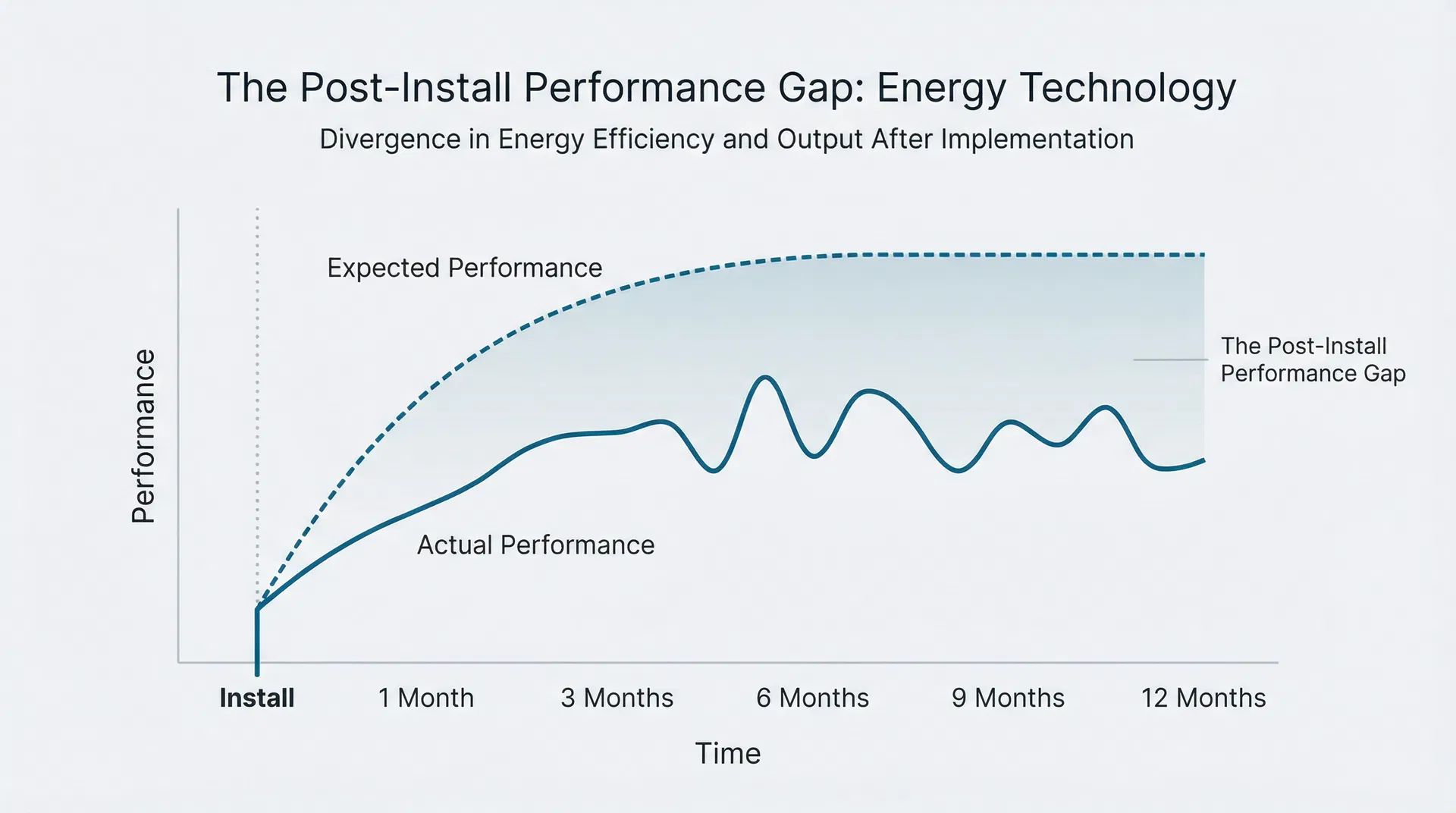
Most energy technology doesn't fail in the lab.
It struggles in the field.
And when it does, the reasons are rarely technical — they're systemic.
Install quality
The gap between how a system is designed to be installed and how it's installed in real homes, by real crews, under real-world time pressure.
Incentive alignment
Installers are often rewarded for completion, not outcomes. Speed is visible. Long-term performance usually isn't.
Homeowner behaviour
People don't read manuals. They override settings. They forget what was agreed during the sales process.
Tariff complexity
Energy pricing is opaque. Most users don't fully understand what they're optimising for — or why it matters.
Missing feedback loops
Once a system is installed, the learning often stops. There's limited visibility into how it performs weeks or months later.
None of these are edge cases. They're the default conditions systems operate in.
Why Installers Take the Heat
When outcomes disappoint, installers are often the first place people look.
But in most cases, they're operating inside constraints they didn't design: products that assume ideal conditions, ideal users, and perfect follow-through.
When real life diverges from those assumptions, friction shows up downstream.
That doesn't mean anyone has failed — it means the system wasn't designed with reality fully in mind.
What the Next Decade Will Reward
The next wave of progress in energy won't come from better hardware alone.
It will come from systems that continue to perform after installation.
That means:
Control layers
Intelligence that adapts to real usage patterns, grid signals, and pricing dynamics.
Feedback loops
Systems that learn from what actually happens, not just what was planned.
Ongoing optimisation
Performance as a process, not a one-time configuration.
Calm, invisible operation
Technology that delivers value without demanding constant attention from the user.
This is where the real leverage is — not at the point of install, but in everything that follows.
It's the layer I'm most interested in understanding properly.
Was this article helpful?
Comments
No comments yet. Be the first to share your thoughts.